 13 hours ago
Natalie ShermanBusiness reporter
 Bloomberg via Getty Images
Betting app Polymarket has announced an investment of up to $2bn from the owner of the New York Stock Exchange
Stew, a 35-year-old from Montana, has enjoyed sports betting since downloading the Kalshi app about 18 months ago.
But recently, after noticing reports of increased pizza deliveries near the Pentagon during late-night scrolling, he placed a different kind of bet — wagering $10 (£7.50) on the odds that Iran's Ayatollah Ali Khamenei would be "out" by March 1.
This trade pushed the boundaries of what kinds of bets Americans are legally allowed to make.
So-called prediction markets — operated by firms like Kalshi — have surged in popularity over the past year, hosting more than $44bn in trades.
They are rapidly reshaping the US betting landscape, where sports betting was mostly illegal until 2018 and election gambling was prohibited until 2024.
While much activity centers on sports, users can speculate on a wide range of questions, including local elections, US central bank interest rate decisions, and even the year of Jesus Christ's return.
The apps gained significant attention during the 2024 US presidential campaign, after a legal victory allowed election betting and odds showed a tilt toward Donald Trump.
However, it is the more grim wagers related to military conflicts involving Iran, Venezuela, and Israel that have recently drawn scrutiny.
In theory, such bets violate US financial regulations, which prohibit trading on contracts involving war, terrorism, assassination, gaming, or other illegal activities.
Despite this, firms have accepted millions of trades on these topics.
Critics have condemned this activity, calling for a crackdown on the apps, which they argue facilitate unethical and potentially illegal war profiteering, pose national security risks, and create opportunities for insider trading and corruption.
"You have now opened up gambling basically on almost anything and it has turned into this very, very gruesome type of thing on the death of a head of state," said Craig Holman, government affairs lobbyist at the Public Citizen advocacy group, which recently filed a complaint over these bets.
Polymarket alone has hosted what Bloomberg estimates as over $500m in bets related to the Iran conflict, at one point offering wagers on the likelihood of a nuclear detonation.
The New York-based company, which operates on a limited basis in the US, removed that market after social media backlash, but users can still bet on questions like when US forces might enter Iran. Polymarket did not respond to the BBC's request for comment.
Kalshi also cancelled the Khamenei market, which had attracted $54m in trades, stating that US-regulated entities are barred from "having a market directly settling on someone's death."
The company, which did not respond to requests for comment, said war bets occur on unregulated exchanges outside the US.
Concerns about war-related bets intersect with a broader debate over how prediction market firms should be regulated.
Unlike traditional gaming companies that set odds, prediction market firms operate more like stock exchanges, allowing users to bet against each other on future event outcomes using "event contracts."
This structure has enabled the US Commodities Futures Trading Commission (CFTC) to claim regulatory oversight.
However, critics argue these firms are essentially sports betting and gambling operations disguised as financial exchanges to avoid stricter regulations and taxes imposed on traditional gaming companies, which are regulated by states.
Disputes over regulatory authority have sparked numerous legal battles across the US, as states seek to regulate these companies like other gaming firms rather than defer to the CFTC.
Even some Republicans have expressed concerns, with traditional gaming firms increasing lobbying efforts, including hiring former Trump official Mick Mulvaney to advocate in Washington.
"Nobody is saying that gambling shouldn't be allowed," said Ben Schiffrin, director of securities policy at Better Markets, an advocate for financial reform. "What the states and other advocates are saying is that things that are gambling should be regulated as gambling."
 Bloomberg via Getty Images
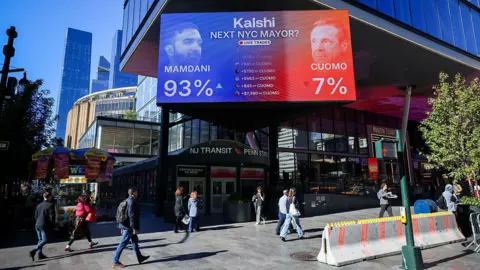
Suspiciously timed bets related to military operations involving Israel, Venezuela, and Iran have intensified calls for regulation.
Regulators have issued consumer alerts about insider trading risks and urged the administration to enforce rules against wagering on war more clearly.
However, the likelihood of a crackdown remains low.
Although the Biden administration initially took a tough stance on the sector, proposing bans on sports and politics-related event contracts, this effort stalled after a court defeat and the 2024 election of Donald Trump, who promised lighter regulation.
Last month, the CFTC announced it would withdraw the proposed ban on sports and election-related contracts.
The CFTC has also supported prediction market firms in their legal battles with states. Michael Selig, Trump's chairman of the CFTC, criticized state actions as "overzealous" in a recent opinion piece.
He argued that event contracts serve "legitimate economic functions," allowing businesses to hedge risks triggered by events.
"It's clear that Americans like the product and want to participate," he said, while emphasizing that platforms must still comply with regulations.
 Bloomberg via Getty Images
In response to mounting pressure, Polymarket has announced measures to better monitor suspicious activity, while Kalshi, which promotes itself as a "regulated exchange," has become more vocal about combating insider trading.
Kalshi recently announced penalties in two insider trading cases and revealed it opened 200 investigations over the past year.
The company also cancelled the $54m market on Khamenei's ouster.
In a series of statements explaining the decision, Kalshi said it does not "list markets directly tied to death," noting this was included in its terms.
It promised to clarify these terms upfront, saying it had "learned a lot" from the incident.
However, the decision sparked outrage among users, including Stew, who said the firm initially "buried" those rules and that the explanation seemed disingenuous, given there were "only a handful of realistic methods" for Khamenei to be removed.
Stew, who received a refund, said he was unsure if regulation was the solution but sympathized with the idea that the debate was mired in semantics.
"They call it contract trading, which I guess technically speaking, that's what it is. But if we're all being honest here, it's still betting," he said.